Three weeks in Thailand with the whole family: the full itinerary, the prices and what not to miss
A 21-day Thailand itinerary for families: where to start, Chiang Mai, Khao Sok and the islands, with hotels, real prices, kosher food and what not to miss.
Three weeks in Thailand with the whole family is one of the best-value trips you can take: a direct flight of about ten hours from Israel, a relatively easy time difference, prices that feel good even for a big family, and a country that manages to be exotic and easy at the same time. The only problem is that Thailand is big and spread out, and it's very easy to turn a dream holiday into a string of domestic flights, ferries and packing. Here's a full 21-day itinerary built precisely so that doesn't happen, with real hotels, real prices, and what you really shouldn't miss.
Why Thailand works so well for a big family
It's a rare combination. On one hand, it's an experience that feels far away and different: golden temples, jungle, elephants, night markets and beaches that look like a screensaver. On the other, the tourist infrastructure is excellent: hotels with pools and family rooms, English spoken everywhere tourists go, and you can book everything from your phone.
And the deciding factor for a family is the ratio of price to experience. A good family meal costs a fraction of what it costs in Europe, hotels at a standard we'd consider luxury are within reach, and a whole day's attraction costs about the same as a single amusement park ticket in Europe. Multiply that by five or six people, and the difference becomes dramatic.
And Thais really do love children. It's not a cliché; you feel it from the first moment in a restaurant, at the hotel and in the market. Waiters will take your toddler for a little walk, market vendors will hand out sweets, and nobody will raise an eyebrow at a baby crying at dinner.
Where to start: Bangkok, then north, then south
All direct flights from Israel land in Bangkok, so that's where you start anyway. The real question is where to go next, and here there's one rule that changes the whole character of the trip: north first, then south, not the other way around.
The reason is simple. You do the "demanding" part of the trip (temples, markets, day trips, jungle, overland travel) in the first week and a half, while everyone is still fresh and curious. You save the last week for the beach: the part where nobody has to wake up at a set time, the kids live in their swimsuits and the adults finally read a book. That way you come home rested rather than wrecked, which is exactly the opposite of what happens to people who start at the beach and then get dragged to a big, sweltering city on the last day.
A bonus: landing in Bangkok in the morning allows a relaxed first day at a hotel with a pool, which is the best way to shake off five hours of jet lag with kids.
When to go: the rule of the two coasts
This is the most important difference, and most people discover it too late. Thailand has two coasts, and each has the opposite rainy season:
- The west coast (Andaman): Phuket, Krabi, Koh Lanta, Phi Phi. Its good season is November to April, peaking from December to March: calm sea, sunshine, barely any rain. From May to October it's wet and wavy there.
- The east coast (the Gulf of Thailand): Koh Samui, Koh Phangan, Koh Tao. Here it's the reverse: the good season runs roughly from January to August, and the heavy rains actually fall in October and November.
Hence the recommendation: the itinerary in this article is built for winter, November to March, when the western islands are at their best. If you're traveling in July or August, swap the beach part for the east coast (there's a section on that below). And if you want both coasts on the same trip, February to April is the best window.
Two more points to mark in your calendar: the famous Maya Bay is closed every year from August 1 to September 30, and the Similan Islands are completely closed from May 15 until about mid-October.
And one price warning: the week between Christmas and New Year's is the most expensive of the year on the islands. When we checked the exact same hotel, four nights in Ao Nang cost about $1,960 in mid-November and about $3,390 for December 24 to 28. Almost double, for the same room. If you're flexible by a week, move it.
The rule that will save your trip: five bases, not fifteen
The most common mistake on a three-week trip to Thailand is trying to "cover" the whole country. The result is eight hotels, four domestic flights, three ferries, and a family that spends half the holiday packing and unpacking.
The itinerary below works by a different rule: only five bases in 21 days, with at least three nights in each. In practice that means only four moves in the whole trip. Instead, you take day trips from a fixed base, and that makes a huge difference, especially when the family includes young children or grandparents.
Days 1 to 4: Bangkok
Bangkok is a sensory shock in the best sense, and four nights is exactly the right amount. Fewer, and you won't get to it all; more, and the heat and the crowds start to weigh on you.
Day 1: landing and unwinding. Don't plan anything. Check in, pool, shower, and in the evening a short outing to an air-conditioned mall or a nearby night market. The kids will fall asleep at 7 p.m. and wake up at 4 a.m., and that's perfectly fine: it passes within two days.
Day 2: the old city. Get up early (everyone's awake anyway) and reach the Grand Palace at opening time, before the heat and the tour groups. Entry is 500 baht per adult, and children under 120 cm get in free. Mind the dress code: shoulders and knees covered for everyone, kids included, so pack thin long pants rather than getting stuck buying a sarong at the entrance. From there, walk to Wat Pho and the 46-meter Reclining Buddha (300 baht, again free under 120 cm), and finish with a short boat ride on the Chao Phraya River to Wat Arun. The boat itself, by the way, is often the attraction the kids remember.
Day 3: a kids' day. Spread the day between the SEA LIFE aquarium under the Siam Paragon mall, Lumpini Park (where real giant monitor lizards live among the ducks, and the kids go wild), and in the evening a modern night market like Jodd Fairs: street food, neon lights and an atmosphere that feels like a festival.
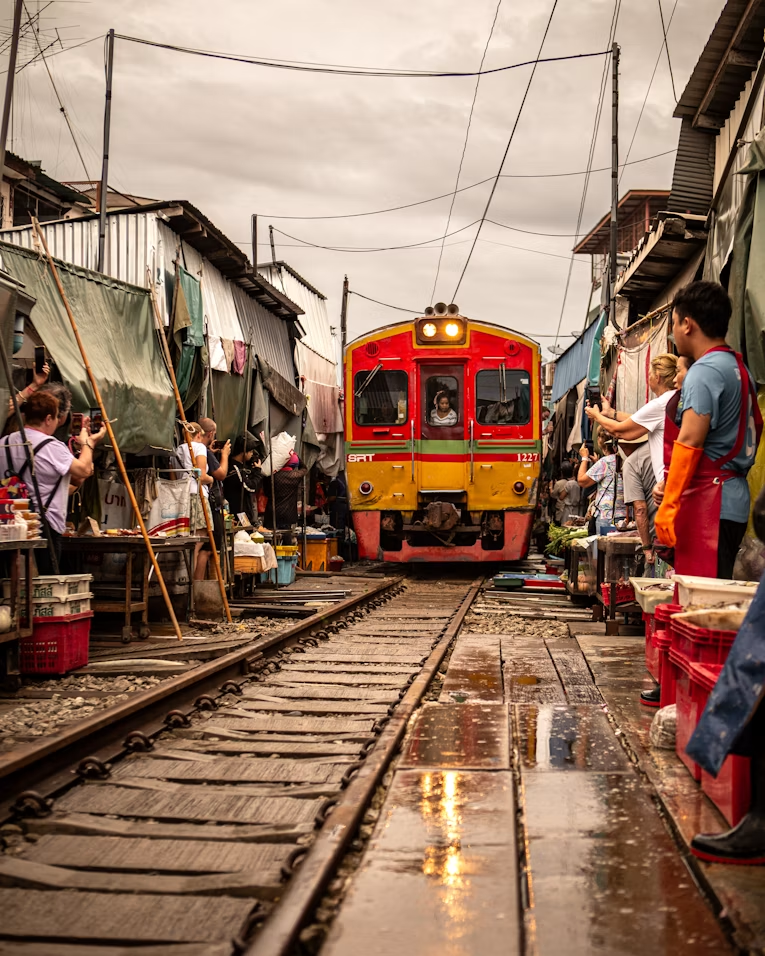
Day 4: a day trip. Two excellent options. The first is Ayutthaya, the old royal capital: a whole field of temple ruins and statues among the trees, including the Buddha head entwined in the roots of a fig tree. The second, for younger kids, is the pair of markets: Damnoen Saduak floating market and, nearby, the Maeklong railway market, where the stalls fold away in seconds as a train passes right through them. It's crazy and unforgettable.
If you prefer history and nature, you can swap this day for Kanchanaburi: the Bridge on the River Kwai, the Death Railway and Erawan Falls, with seven tiers of turquoise pools for swimming. It's a long day (organized tours from Bangkok take about 13 hours), so consider it only if the kids are older, or make it an overnight stay.
Days 5 to 9: Chiang Mai and the north
A one-hour morning flight (from 900 baht per person on the domestic airlines) changes your world. Chiang Mai is cooler, greener and much calmer, and it's the best base in Thailand for five nights with kids.
Day 5: arrival and the old city. A square surrounded by a moat and full of small temples you can wander at walking pace. In the evening, the night market or, if it falls on a weekend, the Sunday Walking Street, one of the most beautiful markets in Thailand.
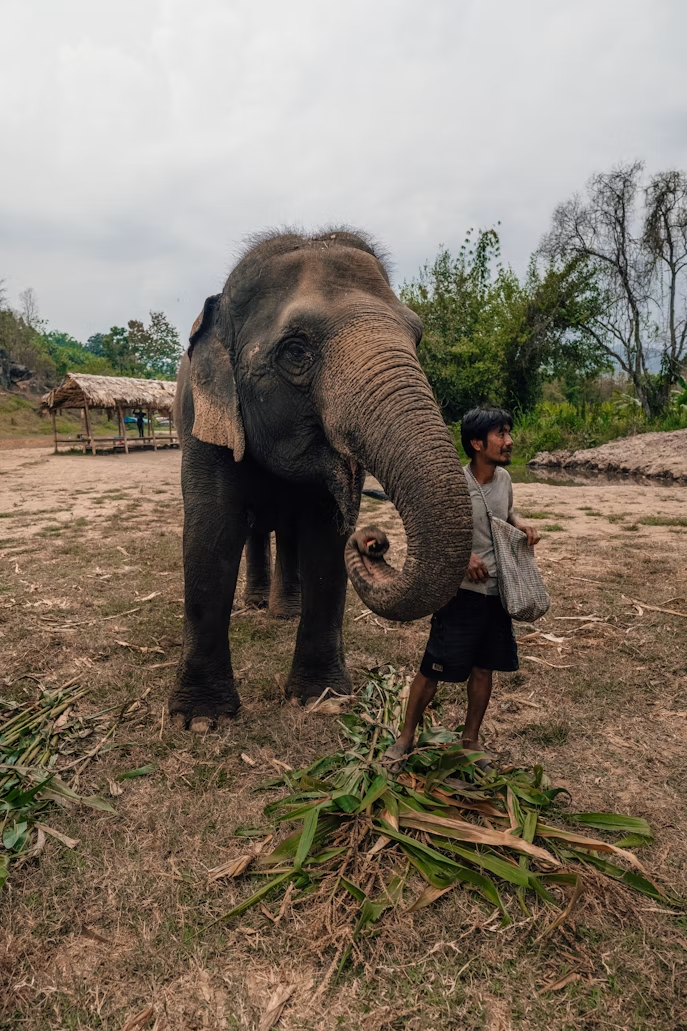
Day 6: the elephants. This is the day everyone will remember. It's very important to choose well: go only to a place with no elephant riding and no shows. A real sanctuary offers feeding, walking alongside the herd and watching, and nothing more. Elephant Nature Park, about an hour and a half from the city, is the best known: more than 100 rescued elephants, a full day for around 2,500 baht per person, including hotel pickup and lunch. Book weeks in advance; it sells out.
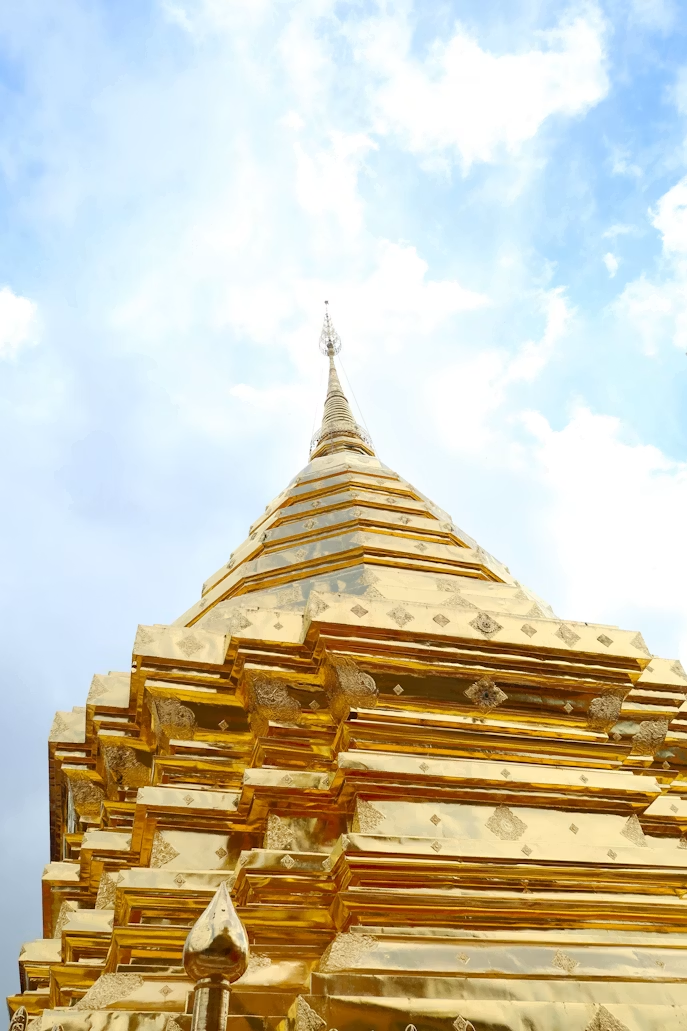
Day 7: Doi Suthep and a cooking class. In the morning, go up to the golden temple overlooking the city (309 steps, or a cable car for those who need it), and in the afternoon take a family Thai cooking class: you shop together at the market, cook and eat what you made. It's one of the activities that works best with school-age kids, and it's also a souvenir that comes home with you.
Day 8: an action day. An adventure park with ziplines and a mountain course down through the jungle, or the "Grand Canyon" water park built inside an abandoned quarry: obstacle courses, giant slides and kayaks.
Day 9: Chiang Rai or a breather. If you have the energy, take a day trip to the famous White Temple (Wat Rong Khun) and the Blue Temple. If you don't (and that's completely legitimate on day nine), stay by the pool, get a massage, and hang out at a nice cafe on the riverbank.
Days 10 to 11: Khao Sok, the chapter nobody expects
Fly south (to Krabi or Surat Thani), and from there drive to Khao Sok National Park: a rainforest more than 160 million years old, one of the oldest in the world, with Cheow Lan Lake at its heart.
And here's what makes this stop the high point of the trip: you sleep on the water. Floating bungalows (bamboo huts or air-conditioned rooms on rafts) are moored in coves between limestone cliffs that rise from the water like something out of a movie. The morning starts with a jump from the deck straight into the lake, and continues with a sunrise boat safari, kayaks, and a cave or a waterfall.
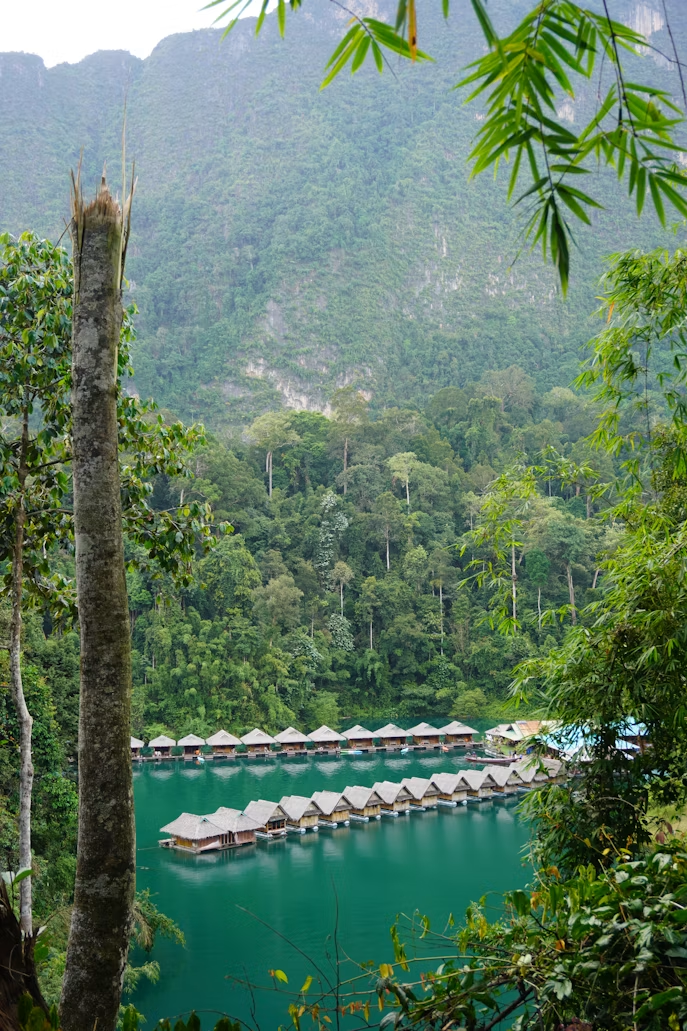
Access is only through a licensed operator and only by boat, since the lake is inside a national park. A two-day, one-night package includes transfers, the boat, lodging, three meals, two safaris and kayaks, and costs about 2,500 baht per adult and 1,800 baht per child.
One night on the lake and one night at a lodge on land is the right split: enough to experience it, not enough for the kids to get bored without internet.
Days 12 to 15: Krabi and Ao Nang
A drive of under three hours, and you're on the west coast. Ao Nang is the best family base in the area: one promenade with restaurants and shops, a beach with longtail boats, and sheer limestone cliffs behind it all.
What to do from there:
- The Four Islands tour: Poda, Chicken Island, Tup and Phra Nang Cave at Railay. By longtail boat it starts from about 895 baht per person, more by speedboat. A tip that transforms the day: go in the afternoon rather than the morning. Exactly the same beaches, half the people.
- Railay: a peninsula you can reach only by boat, with one of the most beautiful beaches in Thailand and rock climbers you can watch for hours.
- The Emerald Pool and the hot springs: a calm inland day in the jungle, ideal for the day after a boat trip.
- The Hong Islands: quieter than the Four Islands, with a lagoon surrounded by cliffs.
If you go to Phi Phi, know that Maya Bay is open but regulated: a park fee of about 400 baht, landing from the back beach, a cap of 380 visitors at a time, an hour on site, and no swimming in the bay itself.
Days 16 to 20: Koh Lanta, the five days that justify everything
A short ferry, and you're on an island that's the complete opposite of Phuket. Koh Lanta is long and quiet, with one stretch of beach after another, one road and almost no nightlife. The water is shallow and calm, so much so that you can actually sit on a beach chair without jumping up every half minute to check on the kids. And prices here are about 20 percent lower than on Koh Samui or Phuket.
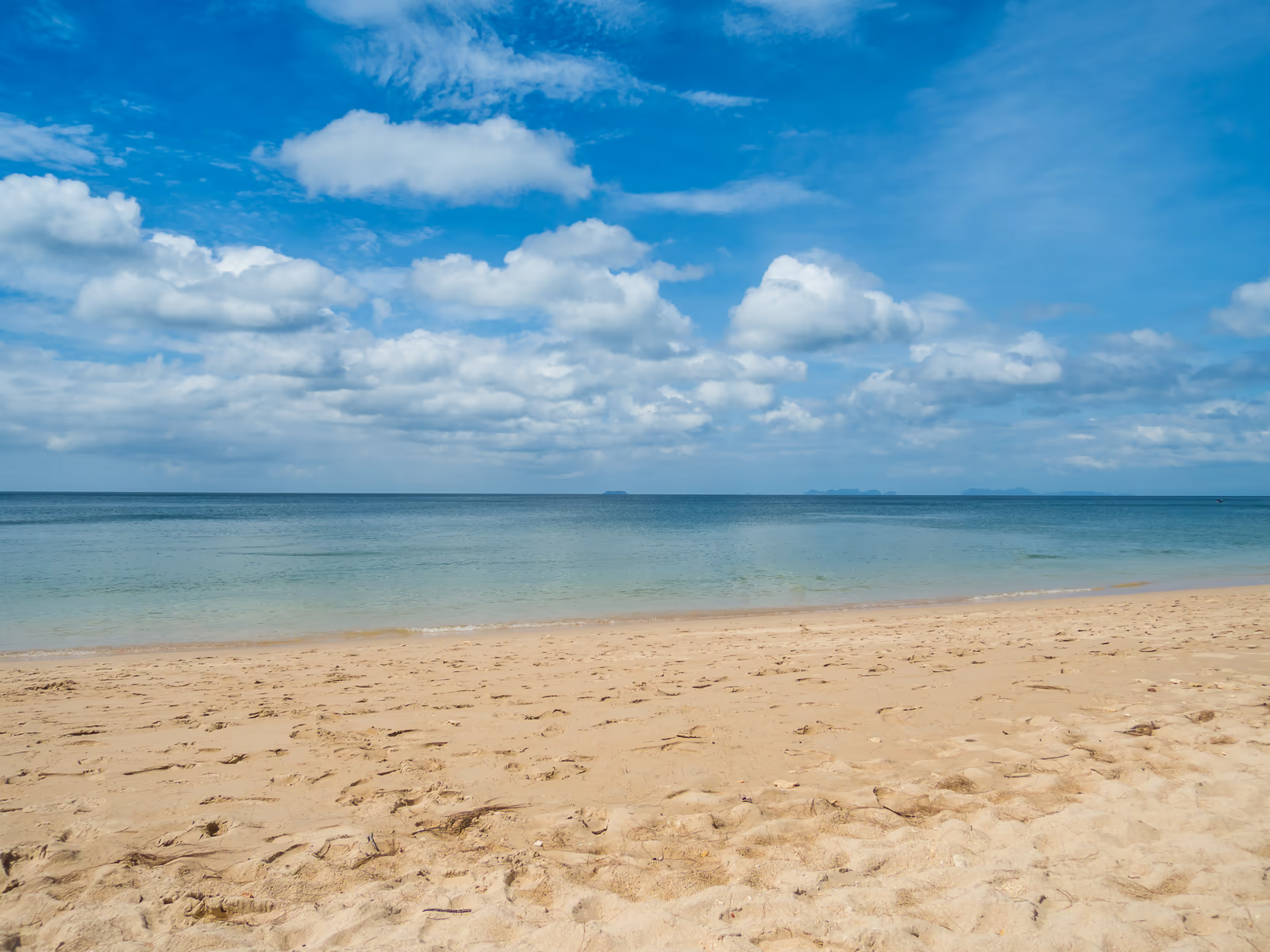
Five nights is a lot, and that's exactly the idea. A day or two of snorkeling at the nearby islands (Koh Rok and Koh Haa are among the most beautiful in Thailand), a morning in the old town with its wooden houses on stilts, maybe kayaking in the mangroves, and the rest of the time, just beach.
Day 21: a ferry or van back to Krabi, a flight to Bangkok, and the flight home. If you can, take a last night in Bangkok near the airport instead of a tight connection; with a family, it's worth every penny.
Where to stay: real hotels and real prices
Here are price ranges actually checked for a family room for two adults and two children, on high-season dates. All prices change constantly, so treat them as ballpark figures, not an offer.
- Bangkok: a wide range. Prince Palace came in around $83 a night, Lamphu Tree House about $109, Tinidee Trendy near Khao San about $144, and The Berkeley Pratunam (5 stars, rated 8.7) about $162. Higher up, the Siam Kempinski or the Marriott Surawongse run around $380 to $640 a night. Recommended neighborhoods for families: Sukhumvit (convenient and modern, near the train), Siam (malls and kids' attractions) or Riverside (beautiful and calm).
- Chiang Mai: At Pingnakorn Riverside around $115 a night, At Chiang Mai about $143, POR Singharat (rated 9.2) about $161. If you want a hotel with a water slide and a kids' club, the Marriott in Chiang Mai is around $359 a night, and the Shangri-La, with a playground and a kids' pool, around $430.
- Khao Sok: the floating bungalow package, as mentioned, about 2,500 baht per adult and 1,800 per child for two days and a night, all included.
- Ao Nang: here you feel the season. In mid-November: Panan Krabi Resort around $405 a night, Anana Ecological about $434, the Holiday Inn Resort (with a water park and a kids' club) about $490. In the last week of December, the same Holiday Inn jumped to about $848 a night. Good, simpler hotels, like Sugar Marina Cliffhanger or Maleedee Bay, run around $270 to $290.
- Koh Lanta: SriLanta around $447 a night in the peak week at the end of December, Royal Lanta about $773, and Lanta Sand about $1,207. Outside that week, prices drop significantly.
Two notes that produce real savings: first, in Thailand two regular rooms often cost less than one family suite, and at many hotels the price gaps between room categories are small, so it's worth checking. Second, at the big hotels, children up to 11 or 12 often sleep free in the parents' bed, with their breakfast included or heavily discounted; this isn't always shown in the first search.
What it costs: a budget breakdown for a family of four
Here's a realistic calculation for 21 days, at a "comfortable but not lavish" level. Amounts are in Israeli shekels (NIS), converted at about NIS 3 to the dollar and about NIS 0.09 to the baht.
- Flights from Israel: a direct round trip to Bangkok runs roughly $900 to $1,200 per person, or about NIS 2,700 to 3,600. For a family of four: NIS 11,000 to 14,500.
- Domestic flights: two or three short flights (Bangkok to Chiang Mai from 900 baht, Chiang Mai to Krabi about 1,500 to 2,800 baht). For the family: NIS 1,200 to 2,000.
- Lodging, 20 nights: an average of about $200 a night across the whole route (cheaper in the north, pricier on the islands): about NIS 12,000.
- Food: a street food dish costs 50 to 80 baht, a good family restaurant meal 600 to 1,200 baht. In practice: NIS 5,500 to 7,500 for three weeks.
- Attractions and tours: elephants, Khao Sok, island tours, classes and entry fees: NIS 4,000 to 6,000.
- Local transport and transfers: Grab rides, vans between cities, ferries: NIS 1,500 to 2,000.
- Insurance, SIM card, shopping and a reserve: NIS 2,500 to 3,500.
Total: about NIS 38,000 to 47,000 for a family of four for 21 days (roughly $12,700 to $15,700 at the same rate), or about NIS 9,500 to 11,500 per person. A truly budget version (3-star hotels, mostly street food, fewer organized tours, shoulder season) comes down to around NIS 26,000 to 30,000, and a pampered version with 5-star resorts and private drivers will easily pass NIS 70,000.
For comparison, the common benchmark for a family of four in Thailand at a mid-range level is $250 to $400 a day, which is exactly the range you get here.
One more point for extended families: above six or seven people, a villa with a private pool and a kitchen becomes cheaper than hotel rooms, and easier to manage too. The islands and Chiang Mai have a big supply, and the difference in comfort is huge.
What not to miss
If you remember only one list from this article, make it this one:
- A longtail boat among Krabi's limestone cliffs: the picture people fly to Thailand for.
- A night in a floating bungalow on Cheow Lan Lake in Khao Sok: what the kids will tell their class about.
- An ethical elephant sanctuary in the north: no riding, no shows.
- The Grand Palace and the Reclining Buddha in Bangkok: yes, it's touristy. And yes, it's spectacular.
- The Maeklong railway market: the moment a whole market folds up and opens again around a moving train.
- A Thai cooking class: a family experience that comes home with you.
- Erawan Falls in Kanchanaburi: seven tiers of turquoise pools you can swim in.
- Doi Suthep temple at sunset: gold against the mountains.
- Snorkeling at Koh Rok or Koh Haa from Koh Lanta: truly clear water, not just in the brochure.
- One evening at a big night market: no plan, just eating and wandering.
And what's better to skip
This is the part "things to do" lists usually skip:
- Elephant riding and animal shows. Simply no. There's a better alternative in every respect.
- Places that let you pet and pose with tigers. Same story.
- Patong in Phuket with kids. A noisy nightlife area that doesn't suit families; if it has to be Phuket, choose Kamala or Mai Khao.
- Squeezing Koh Phangan and Koh Tao into the same trip. They're on the other side of the country, and it will cost you two days of travel.
- Tuk-tuks for long rides. Fun for a ten-minute experience, expensive and problematic for anything else.
- "One day, seven places" tours. In Thailand the heat does its work; two attractions a day is the maximum with kids.
Food: what to eat, and where to find kosher
Thai food is among the most kid-friendly in the world, once you know to ask for "mai phet": not spicy. Pad thai, fried rice, noodles in chicken broth, satay on skewers, mango with sticky rice: all of these go down easily with most kids. Fresh fruit is on every corner, and every 7-Eleven (there's one on every street) has snacks, drinks, yogurt and bread.
For families who keep kosher, Thailand is one of the easiest faraway destinations in the world. It has about 30 kosher restaurants, and there are active Chabad houses in Bangkok, Chiang Mai, Koh Samui and Phuket, and also on Koh Phangan and in Pai.
- Bangkok: a Chabad house with a meat restaurant, a dairy restaurant and a food store. In the Sukhumvit area there's also a kosher shop with a large range of products from Israel.
- Koh Samui: the largest concentration of kosher restaurants in Thailand, including meat and dairy at the Chabad house.
- Chiang Mai: a meat restaurant at the Chabad house, with special meals on Shabbat and holidays.
- Phuket: an active Chabad house with a meat and dairy restaurant, a mikveh and a small grocery; Shabbat meals by advance registration.
Two practical notes: kosher meals are significantly more expensive than local food, so if that's your way, add a generous margin to the budget. And remember that every base on the route above except Khao Sok and Koh Lanta is in a city with a Chabad house, so if you plan around that, you can arrange your nights accordingly.
The logistics nobody likes but everyone needs
- Visa. Israelis enter Thailand without a visa in advance. Currently that means a stay of up to 60 days, but there's a proposal to cut it to 30 days that hasn't taken effect yet, so check the Thai foreign ministry's website before you travel. Your passport must be valid for six months ahead, and you should have a return or onward ticket.
- Digital arrival card (TDAC). Mandatory for everyone entering Thailand, submitted online within 72 hours before landing (not earlier, or it's rejected). Submission is free on the official site, tdac.immigration.go.th. Dozens of sites charge $10 to $50 for it; don't fall for them.
- Getting around town. Install Grab (and Bolt alongside it) before the flight. The price is fixed in advance and the ride is recorded. If a driver calls and asks you to cancel the booking and pay cash, refuse; it takes you out of the system. Never get into a tuk-tuk without agreeing on the price first.
- Common scams. A driver who offers a "cheap tour" and insists on stopping at a gem shop or a tailor is the oldest scam in Bangkok; don't go in. And if a driver offers to buy beer on the way at a 7-Eleven, refuse: there's a known version where it ends with a fine at a police checkpoint.
- eSIM. Buy one before the flight. It saves the line at the airport and lets you order a Grab as soon as you land.
- Health. There are no mandatory vaccinations for Thailand, but it's worth seeing a travel clinic a month or two before. Bring sunscreen, mosquito repellent, something for burns and basic medicines. Drink only bottled water. Travel insurance with medical and evacuation cover is not a luxury: private medical care in Thailand is excellent but costs money.
- Cash. Cash baht still rules in the markets, on the boats and at the stalls. ATMs are everywhere, but they charge a fixed fee, so withdraw larger amounts less often.
If you travel in summer: the Gulf of Thailand version
July and August are the big summer vacation in Israel, and that's exactly the season when the west coast is wet. The solution is simple: keep the northern half of the itinerary exactly as it is, and swap the south.
Instead of Khao Sok, Krabi and Lanta, fly to Koh Samui and split the last ten days between Samui and Koh Phangan. Samui is one of the most family-friendly islands in Thailand: it has an airport, hospitals, hotels at every level, and the Fisherman's Village in Bophut for evenings. From there, take a full day at Ang Thong Marine Park: 42 islands, hidden lagoons, snorkeling and kayaks (a long day in the sun, less suitable for toddlers). Add the Secret Buddha Garden in the heart of the island, and you get a full beach holiday exactly when the Andaman is closed by rain.
Grandparents on the trip: how to keep everyone happy
A multigenerational trip is a rare opportunity, and it's also where poor planning breaks down fastest. A few rules that work:
Choose hotels with an elevator and rooms on one level: Thailand has many beautiful "bungalow" resorts spread over a hillside, and that's exhausting for anyone whose knees aren't at their best. Plan each morning around just one activity, and leave the afternoon hours (1 p.m. to 4 p.m., by far the hottest) for the pool and rest. Prefer boat trips to walking tours: the sea is the great equalizer, and everyone enjoys it equally. And give advance permission for days when the grandparents stay at the hotel while the parents and kids go out; that's not a failure of the itinerary, it's a good itinerary.
One more thing: shared dinners are the glue of a trip like this. In Thailand it's especially easy, because almost every restaurant serves dishes to the middle of the table, which turns every evening into a real family meal.
What to pack (the short list that really matters)
Thin, quick-drying clothes, but also long pants and covered shoulders for the temples. Closed water sandals, since many Andaman beaches are full of coral and stones. High-SPF sunscreen (very expensive there) and mosquito repellent. A poncho or a thin rain jacket. Waterproof pouches for phones on boat trips. A soft bag rather than a huge suitcase for the island part. And one thin sweater for everyone: in the north in winter the evenings really are cool, and Thai air conditioning doesn't hold back either.
Thailand is a trip for older kids and for families who have already done a few short trips. If you're not there yet, the family trip abroad guide explains why, and which destinations to start with.
From this list to a real itinerary
The hardest part of a trip like this isn't choosing where to fly. It's translating everything you just read into a calendar: which attraction on which day, what's near what, how long it takes to get between them, where to sleep at each stop, and how it all fits with the budget, with the three-year-old and with grandma. That's what Diretix does for you: you choose the destination, the dates and who's in the family, and the system builds a full daily schedule with age-appropriate attractions, real distances and travel times, lodging recommendations and a daily budget, in minutes. One trip a month is built in full, for free, up to 12 days.
Want this as a real itinerary?
Tell us where and when, and the AI builds a full day-by-day itinerary for you in minutes.